
Separated?
Divorced?
CATHOLIC?
You Are Not Alone.
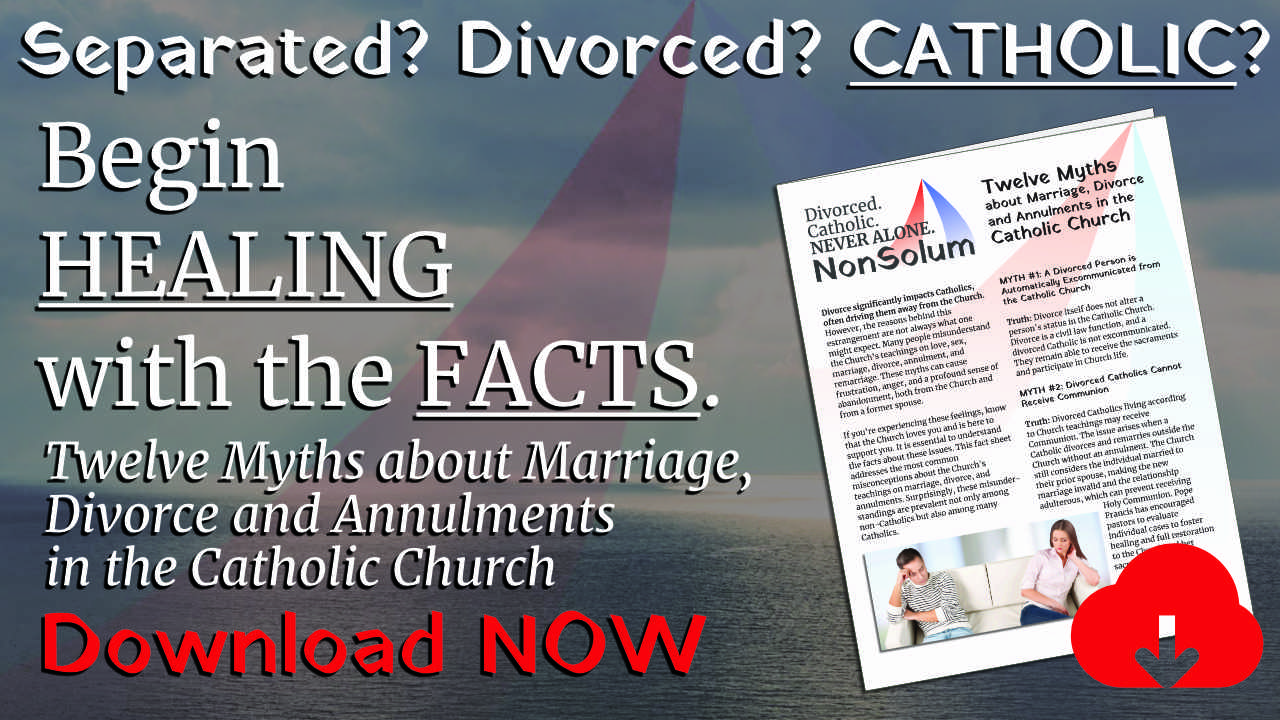
Click to play
A Pastoral Community…
For those of us who have experienced–or are enduring right now–the AGONY of marital separation and divorce, those challenges can be even greater as CATHOLICS. Fortunately, the Church has begun to better understand the reality of what happens when no one ministers to the emotional and spiritual needs of these members:
• They can feel doubly rejected and get angry or depressed.
• They may end up hating the Church or, worse, God.
• They may leave the Church to go where they feel more welcomed and accepted.
Non Solum Columbus is a pastoral community of separated and divorced CATHOLICS. Also found on Meetup, the apostolate and pastoral community formed in December, 2014 specifically to help reach out to those Catholics who don’t want to see their faith go the way of their marriage. Its purpose is to provide love, support, guidance, and healing—by other Catholics who have experienced it themselves, and have faced similar challenges.
 Support programs and gatherings, primarily focused on Surviving Divorce: Hope and Healing for the Catholic Family (formerly known as The Catholic’s Divorce Survival Guide), are occurring in parishes and other locations throughout the Columbus Diocese. Our gatherings are always being planned and will be posted and shared here and on Meetup as they are set. Join us to immediately be notified.
If you have any specific questions, feel free to contact us.


Commonly Asked Questions:
Q1: Am I excommunicated because I got divorced?
No. Divorced Catholics are not excommunicated. This is one of the most widespread and damaging myths about divorce in the Catholic Church, and it is false. Divorce by itself has never been grounds for excommunication.
A divorced Catholic remains a member of the Church and is encouraged to participate fully in her life. The Church does not cast out those who have suffered divorce. On the contrary, she calls them to remain close to Christ and to continue in prayer, Mass, and the sacramental life.
The U.S. Catholic Catechism for Adults puts it plainly: when civil divorce is the only possible recourse, the Church seeks to support those involved and encourages them to remain close to the Lord.
Part of the confusion comes from an older disciplinary rule in the United States. In 1884, the U.S. bishops established a regional norm imposing excommunication on Catholics who attempted remarriage after divorce without an annulment. That penalty did not apply to those who were simply divorced, and it was rescinded in 1977. It is no longer in effect.
If you are divorced, you are not outside the Church. You belong here. The Church wants to walk with you in truth and mercy.
Q2: Can divorced Catholics receive Communion?
Yes. A Catholic who is divorced but has not entered a new union may receive Holy Communion, provided he or she is otherwise properly disposed and in a state of grace (this is the case for EVERYONE, regardless of marital status!). Divorce by itself does not bar anyone from the Eucharist.
The situation is different for Catholics who have divorced and then civilly remarried without a prior declaration of nullity. The Church presumes a prior marriage to be valid unless and until the contrary is established. Because of that, a new union entered while a prior marriage bond is still presumed to exist is an objectively irregular situation.
For that reason, such persons are ordinarily not free to receive Holy Communion unless and until their situation is resolved. The path forward may include seeking a declaration of nullity, pursuing convalidation if possible, or, in some cases, living as brother and sister while remaining committed to the life of the Church.
Pope Francis, in Amoris Laetitia, called pastors to accompany people in difficult situations with patience, honesty, and mercy. That pastoral care is important, but it does not change the Church’s teaching on marriage or the need to respect the Eucharist.
The bottom line is simple: if you are divorced and have not entered a new union, divorce alone is not a barrier to Communion. If you have remarried without a prior annulment, speak with a faithful priest about the next steps.
Q3: Does the Catholic Church require me to stay in an abusive marriage?
Absolutely not. The Catholic Church has always recognized the right to physical separation from a dangerous spouse. No one — under any circumstances — is required to remain in a situation of abuse, violence, or serious threat to themselves or their children. Your safety and the safety of your children come first.
The Church teaches that marriage is indissoluble, meaning it cannot be ended sacramentally by a civil divorce. But indissolubility does not mean you must live under the same roof as someone who is harming you. Canon law explicitly provides for the separation of spouses when one partner causes grave danger to the other (Canon 1153). The Catechism of the Catholic Church (no. 2383) affirms that civil separation — and even civil divorce — can be tolerated when it is the only practical way to ensure certain legal rights, the care of children, or the protection of inheritance.
This distinction matters enormously, because the myth that "the Church forces you to stay" has kept people — overwhelmingly women — trapped in dangerous homes. It is a lie, and it costs lives.
If you are in an abusive situation: get to safety first. Then seek pastoral guidance from a priest who understands these situations. You are not sinning by protecting yourself and your children. The Church is with you, not against you.
Q4: Isn’t an annulment just "Catholic divorce"?
No. A divorce and an annulment are two very different things. A divorce focuses more on how a marriage ended. An annulment focuses on how the marriage began.
A civil divorce is a legal action that ends a civil marriage contract. An annulment, more properly called a declaration of nullity, is a judgment by a Church tribunal that a valid marriage bond was not established from the beginning.
In other words, a divorce says, “this marriage has ended in civil law.” A declaration of nullity says, “after careful examination, the essential conditions required for a valid marriage were not present at the time of consent.”
This does not mean the relationship was unreal, that the couple never cared for each other, or that the years they spent together did not matter. It means that, for specific reasons recognized by the Church, a true marital bond was not brought into being.
This is not a loophole. The Church takes marriage so seriously that she carefully examines whether the parties were truly capable of entering it and whether they actually gave the kind of consent marriage requires.
Common grounds can include lack of canonical form, grave defect of consent, psychological incapacity regarding the essential obligations of marriage, or the exclusion of an essential property of marriage such as permanence, fidelity, or openness to children.
Q5: Am I still Catholic if I'm divorced?
Yes, without question. Your Catholic identity comes from your Baptism — and nothing, including divorce, can take that away. You are a Catholic. You are a member of the Body of Christ. That has not changed and will not change.
This may sound obvious, but the emotional reality of divorce can make it feel otherwise. When you're sitting in the pew alone for the first time, when well-meaning (or not-so-well-meaning) parishioners say hurtful things, when you wonder whether you even belong — it can feel like the Church has moved on without you. It hasn't.
The Catechism of the Catholic Church (no. 1651) urges that divorced Catholics "not consider themselves separated from the Church, in whose life they can and must participate as baptized persons." The word must is important there. It's not optional. The Church doesn't just tolerate your presence — it calls for it.
You can attend Mass. You can pray. You can serve. You can participate in parish life. If you are divorced and have not remarried outside the Church, you can receive the Sacraments fully. And even in more complex situations, there are paths forward — the Church wants to walk them with you.
Q6: What actually happens in the annulment process?
The annulment process is a formal investigation by a Church tribunal to determine whether a valid marriage bond existed from the beginning. It usually begins when you, often with help from a priest, deacon, or trained parish advocate, submit a petition to the tribunal.
In general, the process includes these steps:
First, an initial meeting. Someone trained in the process helps you understand what the Church is asking and what materials will be needed.
Second, the petition. You provide a written history of the relationship and marriage, including circumstances before and during the marriage that may be relevant to its validity.
Third, witnesses and participation by the other party. The tribunal usually asks for witnesses who knew you and your former spouse and can speak to the circumstances. Your former spouse is also contacted and given the opportunity to participate, though the case can often proceed even if that person chooses not to respond.
Fourth, tribunal review. Judges and canonists study the testimony and evidence in light of the Church’s teaching and law.
Fifth, a decision. The tribunal either grants or does not grant a declaration of nullity. If nullity is established, and if no other impediments exist, a person may be free to marry in the Church.
Timelines vary widely depending on the diocese and the complexity of the case. Pope Francis did simplify aspects of the process in 2015 through Mitis Iudex Dominus Iesus, and many dioceses have reduced or eliminated fees. Financial hardship should not keep anyone from asking about the process.
Q7: Will my divorce affect my children's sacraments?
No. Your divorce does not in itself prevent your children from receiving the sacraments. A child’s eligibility for Baptism, First Holy Communion, Confirmation, and the rest of the sacramental life is not taken away because his or her parents are divorced.
This is a common fear, but it is unfounded. Your children are not punished for the breakdown of their parents’ marriage. Their sacramental life flows from their own relationship to Christ and the Church.
Likewise, if a marriage is later declared null, that does not make children “illegitimate.” Canon law is explicit that children born of a putative marriage are legitimate, even if that marriage is later declared null.
As with any family, the usual pastoral preparation for the sacraments still applies. But divorce by itself is not a reason to delay or deny your children’s reception of the sacraments.
If anyone has told you otherwise, they were mistaken.
Q8: How does the Church approach Catholics who have divorced and remarried without a prior annulment?
The Church approaches these situations with both truth and mercy. She does not reject people who are in difficult marital situations, but neither does she set aside Christ’s teaching on the permanence of marriage.
When a Catholic is divorced and civilly remarries without a prior declaration of nullity, the Church ordinarily regards that new union as irregular, because the first marriage is presumed valid unless and until the contrary is proven. For that reason, the person is called to remain engaged in the life of the Church, but is ordinarily not free to receive Holy Communion unless the situation is resolved.
That does not mean the person is cast out. It means the Church is called to accompany that person pastorally and honestly. Pope Francis emphasized in Amoris Laetitia that pastors should walk with people in difficult situations, helping them take concrete steps toward greater fidelity to Christ and His Church.
Those steps may differ from case to case. They can include examining whether the first marriage was valid, beginning the annulment process, seeking convalidation where possible, or, in some circumstances, committing to live in continence. Pastoral accompaniment matters deeply, but it must remain faithful to the Church’s doctrine and sacramental discipline.
If you are in this situation, you should not assume there is no place for you in the Church. There is. But the way forward should be sought with a priest who is both compassionate and faithful to the Church’s teaching.
Q9: I didn't want this divorce. My spouse left me. What does the Church say about that?
The Church recognizes a clear moral distinction between the person who causes a marriage to break down and the person who suffers its breakdown. If your spouse abandoned you or initiated the divorce despite your efforts to save the marriage, the Church does not consider you to be at fault, and your situation is viewed with particular pastoral compassion.
The Catechism of the Catholic Church (no. 2386) explicitly addresses this: "It can happen that one of the spouses is the innocent victim of a divorce decreed by civil law; this spouse therefore has not contravened the moral law."
This is an incredibly important point, because many abandoned spouses carry guilt and shame that doesn't belong to them. You didn't break a vow. You didn't walk away. You are not in sin because someone else chose to leave.
If you are divorced, have not remarried, and are striving to live faithfully, you remain in full communion with the Church. You can receive the Sacraments. You can serve in ministry. You have not done anything wrong by enduring what was done to you.
The pain is real, the grief is real, and the sense of failure can be overwhelming — even when you know intellectually that it wasn't your choice. That's where pastoral support, community, and programs like Surviving Divorce become essential: not because you need to be "fixed," but because you don't have to carry this alone.
Q10: What is the Surviving Divorce program?
Surviving Divorce: Hope and Healing for Catholic Families is a 12-session video-based program designed specifically for Catholics navigating the pain of separation and divorce. Created by Rose Sweet and published by Ascension Press, it combines expert teaching, personal testimonies, and small-group discussion in a safe, faith-centered environment.
The program covers the full range of what separated and divorced Catholics face: the shock and grief of a marriage ending, the spiritual crisis that often follows, practical guidance for navigating parish life, co-parenting, dealing with anger and forgiveness, and rebuilding a healthy sense of self — all within a Catholic framework.
Each session includes a video presentation featuring Catholic experts and real people sharing their stories, followed by small-group discussion guided by a trained facilitator. You don't have to share more than you're comfortable with. Many participants say it's the first time they've been in a room (or virtual room) with other Catholics who truly understand what they're going through.
Non Solum offers Surviving Divorce cohorts both in-person (in the Columbus, Ohio area) and online — so geography is not a barrier. Whether you're freshly separated or decades past your divorce, the program meets you where you are.
You don't have to be "ready." You don't have to have it together. You just have to show up.
Q11: Can divorced Catholics serve in parish ministry — as lectors, Eucharistic ministers, or in other roles?
Yes. Divorce alone does not disqualify a Catholic from serving in parish ministry. A Catholic who is divorced and otherwise in good standing with the Church may be able to serve as a lector, catechist, extraordinary minister of Holy Communion, parish volunteer, or in other roles.
At the same time, some ministries are subject to diocesan norms and the pastor’s judgment, especially where public witness and questions of canonical status are involved. For that reason, a divorced Catholic who has not entered a new irregular union is generally not barred from ministry simply because of the divorce itself, while more complex situations may require pastoral review.
In practice, some divorced Catholics have been treated as though divorce alone made them unfit to serve. That is not consistent with the Church’s teaching. Divorce by itself is not a moral or canonical disqualification from parish life or ordinary forms of service.
If you have been told that you cannot serve solely because you are divorced, it is reasonable to ask for clarification from your pastor or diocesan office. The Church needs the gifts of those who have suffered, remained faithful, and continued to seek Christ.
If you want, I can also do a second pass and tighten the tone across the whole set so it sounds more consistently Catholic and a little less reactive.
Q12: I'm divorced and thinking about leaving the Catholic Church. Why should I stay?
We understand why you'd feel that way — and we'd be lying if we said otghers haven't felt that way themselves. To say that it sucks to experience divorce is an understatement on its own…but if you’re Catholic, it can be even more difficult.
The pain of divorce is hard enough without feeling like the community that's supposed to sustain you has turned its back on you. And for many divorced Catholics, the experience of judgment, misunderstanding, or simply being invisible in a family-centered parish is enough to make walking away feel like the only option.
But here's what we want you to know: most of the reasons divorced Catholics leave the Church are based on things that aren't actually true. They believe they're excommunicated (they're not). They believe they can't receive Communion (in most cases, they can). They believe the Church sees them as failures (it doesn't — and the late Pope Francis was emphatic about this throughout his pontificate). They leave because of myths, not because of actual Church teaching.
And sometimes they leave because they encountered an "all rules, no mercy" response from a particular priest, deacon, or parishioner — and assumed that response was the Church. It wasn't. Most Catholics genuinely want to do better by their divorced brothers and sisters. The Church is not the worst experience you've had in it.
The Church is imperfect. Its members are imperfect. Some of them will say hurtful, ignorant things about your divorce. But the Sacraments are real. The Eucharist is real. And your Baptism is real — it binds you to something bigger than any one parish's shortcomings.
You don't have to figure this out alone. That's why communities like Non Solum exist: Catholics who've been exactly where you are, who stayed (or came back), and who want to walk with you. Not to lecture you. Not to fix you. Just to be there.
You are not alone. That's not a slogan — it's a promise.